

In a world of our own

Donna Ahern examines how leading brands and retailers are strengthening their sustainability credentials and connecting with eco-conscious consumers
 Print
Print24 March 2026

Sustainability is no longer a “nice to have” — it has become a key decision-driver for today’s consumers. Shoppers increasingly expect brands and retailers to take meaningful action on packaging, sourcing and environmental impact.
In Budget 2026 (Ireland), Minister for Climate, Energy and Environment Darragh O’Brien announced an investment of more than €1.1 billion to accelerate Ireland’s energy transition and support the country’s journey to net zero. The government also extended the VAT reduction on electricity and gas bills from 13.5% to 9% until 31 December 2030.
Speaking on Gov.ie, O’Brien said the budget supports efforts to protect the environment, combat climate change and transform Ireland’s energy system to ensure energy remains secure, sustainable and affordable.
Minister of State for the Circular Economy Alan Dillon said the budget helps lay the foundation for a more circular economy where waste is designed out and resources are kept in use longer. Increased investment in landfill remediation and stronger waste enforcement will support the implementation of Ireland’s second Whole-of-Government Circular Economy Strategy and accelerate the shift toward reuse, repair and recycling.
Meanwhile, Re-turn, administrator of Ireland’s Deposit Return Scheme (Ireland), recently marked a major milestone: 2.5 billion drinks containers returned since the scheme launched in February 2024. Public participation continues to grow, with more than 1.4 billion cans and bottles returned in 2025 alone, following 874 million returns during the scheme’s first year.
As a result, recycling rates for eligible containers have increased from 49% before the scheme to more than 90%. Around 76% are now captured directly through the DRS, with the remainder collected through mixed recycling.
The return network has expanded to 3,750 return points nationwide, including additional reverse vending machines, bulk-feed units and bin surrounds to support on-the-go recycling. Pilot infrastructure has also been introduced on the islands of Arranmore, Cape Clear and Inishturk.
CEO Ciaran Foley said the scheme has become part of everyday life in Ireland and is delivering measurable environmental benefits.
According to Irish Business Against Litter, cans and plastic bottles are now 60% less common in litter nationwide since the scheme was introduced in early 2024.
Paul Cullen, commercial fuels manager, Applegreen

(L‑R) Thomas Hevey, Kevin Barron and Paul Cullen at Applegreen Ballymount
Q: What is driving Applegreen’s investment in expanding its EV charging and HVO network, and how does this programme support your wider sustainability and decarbonisation objectives across the estate?
A: Applegreen’s investment in EV charging and HVO is driven by a practical, customer led approach to decarbonisation. Our network serves a diverse mix of private motorists, commercial fleets, and heavy duty operators, all of whom are transitioning at different speeds. EV demand is growing rapidly, particularly across national routes, so we are expanding high power charging at strategic locations to ensure fast, reliable and safe charging for drivers. EV is now a core part of our operational model, and we are scaling it with the same discipline we apply to our fuel and retail operations.
HVO complements this by providing an immediate, drop in lower carbon solution compared to traditional diesel for sectors where complexities exist for electrification in the short to medium term. Logistics, construction and service fleets need a fuel that reduces emissions without disrupting operations, and HVO enables that transition with minimal change to existing infrastructure. Together, EV and HVO allow us to support Ireland’s climate ambitions while ensuring our estate remains commercially strong, customer focused and future ready.

Applegreen EV Fuel Card
Q: How does integrating EV charging and HVO into the Applegreen Fuel Card proposition support fleet operators and business customers in reducing emissions while maintaining operational efficiency and cost control?
A: The Applegreen Fuel Card is designed to simplify the transition for mixed fleets. By integrating EV charging, HVO and traditional fuels onto a single platform, we remove complexity for fleet managers who need clear reporting, cost control and operational consistency. For EV users, the Fuel Card provides controlled access to our high power charging network, with consolidated billing and transparent usage data. For HVO users, it delivers the same convenience, familiarity and cost visibility as diesel, but with significantly lower lifecycle emissions.
We have also upgraded the physical card itself, it is now produced using recycled materials, reducing the product’s environmental footprint without compromising durability or security.
This integrated approach gives businesses a practical, scalable way to manage their transition strategy, track carbon impacts and maintain operational efficiency as their fleets evolve.
Q: What early results or KPIs are you seeing from the rollout of EV chargers and HVO, and how are you measuring impact across your network?
A: We are seeing strong early momentum across both our HVO and EV fast charge network. EV utilisation continues to rise month on month, with reliability and speed emerging as key factors for customers. Satisfaction with our EV experience remains consistently high, reflecting our focus on charger reliability, ease of use and the availability of high quality on site services during charging dwell time.
HVO uptake is also growing steadily, particularly among early adopting logistics fleets. These operators are reporting meaningful emissions reductions without any operational compromise, reinforcing the value of offering HVO at scale.
We measure progress using operational KPIs such as charger uptime, utilisation rates and HVO availability. These insights ensure we invest where demand is strongest and where we can deliver the greatest environmental impact.
Q: What are the main challenges in scaling EV and HVO infrastructure at forecourt level, and what does your roadmap look like over the next 12–24 months?
A: Scaling EV and HVO infrastructure involves a mix of technical, operational and commercial considerations. For EV, aligning installation timelines with site development can be challenging, particularly for high power charging, which requires significant grid capacity and investment. Our focus is on locations where customer demand, dwell time and long term utilisation support that level of infrastructure. For HVO, the priorities include maintaining consistent supply, ensuring commercial competitiveness and supporting customers as they understand how the fuel performs within their own operations while transitioning to lower carbon alternatives.
Britvic Ireland: Sustainably local

Britvic Ireland
Britvic Ireland, part of the Carlsberg Group, is the largest Soft Drinks and Bottled Water Manufacturer in the Republic of Ireland. A commitment to Sustainability is at the heart of its strategy, and it strives for its vision of a world where great packaging never becomes waste.
Britvic Ireland holds Gold member certification with Origin Green, Ireland’s pioneering food and drink sustainability programme and the only national-level sustainability programme of its kind in the world. An accredited member since 2015, it is proud to have been awarded Gold status this year based on achieving exemplary performance against 5 target areas of Packaging, Energy and Emissions, Health and Nutrition, Diversity, Equity and Inclusion and Supplier Certification. In awarding Gold membership, the auditors particularly called out Britvic Ireland’s achievements in the Health and Nutrition space, exceeding the calorie reduction target by 20% in 2024 as a result of product reformulation and successful low-calorie innovations such as Ballygowan Hint of Fruit.
Packaging circularity is a key part of Britvic’s strategy, and as of the start of 2026, all Britvic on-the-go drink bottles are made from 100% recycled PET. Britvic strongly supports the Deposit Return Scheme in order to ensure a circular flow of materials, and MD Kevin Donnelly was recently re-elected to the Re-Turn board representing soft drinks producers.
A founding member of Love Irish Food at Britvic, it believes the simplest way for retailers to reduce the environmental footprint of their portfolio is to source trusted local brands. The majority of its drinks are bottled in Ireland at its Dublin and Newcastlewest bottling facilities, and its dedicated Sustainability team is always keen to collaborate with retailers on creating a greener future.
Born to create premium spirits in the most environmentally friendly way

‘Environmentally responsible Whiskey and Gin production with dedication to quality, sustainability, and authenticity.’
Tucked away in the quiet, rural Irish village of Ahascragh lies one of the most advanced and groundbreaking achievements in the history of the Irish whiskey industry. Born from the lovingly restored ruins of an old 19th-century corn mill, Ahascragh Distillery has engineered a way to make premium Irish whiskey and gin while releasing zero emissions from its power source into the atmosphere. It has become the first distillery in the country to do this, but hopefully it will not be the only one to do so as Ahascragh Distillery leads the sustainability revolution within the Irish whiskey industry.
Ahascragh Distillery was not just born to create premium Irish whiskey and gin; it was born to create these spirits in the most environmentally friendly way. For the distillery’s founders, husband and wife team Gareth and Michelle McAllister, the process of making the spirit was just as important as the end product being produced at the end. This is because they had an idea, an idea that was widely believed to be impossible: implementing heat pumps into the distillation process. This simple idea would allow their distillery to run fully from renewable electricity sources and ditch oil, gas and other fossil fuels completely.
The result of this engineering breakthrough is a distillery that produces whiskey with roughly 98% less carbon emissions than its peers in the industry. While currently selling a range of premium, innovatively finished, sourced release whiskey, Ahascragh Distillery will be releasing Ireland’s first zero-energy emission whiskey in early 2027, marking a huge leap forward for the sustainability of what is a traditionally very energy-intensive sector.
Heineken Ireland’s commitment to Brew a Better World

(L‑R) Tomás Sercovich, CEO, BITCI and Sharon Walsh, managing director, Heineken Ireland
This year, Heineken Ireland’s Lady’s Well Brewery celebrates 170 years of brewing in Cork – a legacy that continues to shape how it approaches its responsibilities today. While it has evolved its portfolio and scale significantly over that time, its commitment to quality, innovation and responsible business remains constant.
Today, sustainability is embedded across the company through its Brew a Better World strategy. It is focused on raising the bar on sustainability and responsibility across its value chain, from reducing carbon emissions and waste to promoting responsible consumption and supporting inclusive workplaces.
A key pillar of the sustainability strategy is Responsible Consumption, ensuring consumers have access to information and a broad range of options that allow them to enjoy beer responsibly. It has long been believed that it should use the power of its brands to make moderation not just acceptable, but aspirational, with Heineken 0.0 now Ireland’s leading zero alcohol beer, and it is expanding the portfolio with Moretti Zero.
Its recent report Always a Choice: How Socialising is Changing in Ireland explores the consumer shifts where 87% of respondents said some of their most enjoyable social moments happened while moderating, or not drinking alcohol at all. It is proud of its collaboration with customers that is helping create social norms around moderation, through product innovation, responsible partnerships and sustained investment in alcohol-free options.
Sustainability at Heineken also extends to how it operates and supports its people and communities, including creating a fair and equitable workplace. In 2025, it reported a Mean Gender Pay Gap of -0.09%, marking four consecutive years of sustained pay equity and reflecting deliberate actions taken to promote fairness and equal opportunity across its organisation.
It has also exceeded its target of achieving 43% female representation among middle-senior leaders, reaching 49% in 2025 through focused programmes and policies designed to promote gender equity.
Heineken Ireland is also working with customers to support inclusive employment across the wider industry. In partnership with AssistiV, a Social Enterprise that has created personalised assistive technology, it is helping to create employment opportunities for people with disabilities within the hospitality and retail sectors.
It recognises that the challenges it faces today are too complex for any one company to solve alone, and that achieving its ambitions requires collaboration across its value chain and with its external partners. Through its work with Business in the Community Ireland (BITCI), it is proud to be part of a group of leading organisations committed to driving meaningful change.
Heineken Ireland was reaccredited in 2025 with BITCI’s Business Working Responsibly Mark, Ireland’s leading standard for sustainable and responsible business practices. The Mark recognises organisations that go beyond compliance to embed sustainability, accountability and continuous improvement across their operations. It first achieved the Mark in 2018 and remains the only drinks company in Ireland to hold the accreditation.
Heineken Ireland continues to raise the bar on sustainability by expanding consumer choice, strengthening responsible business practices, and building on a 170-year legacy of partnership with retailers, customers and communities. By focusing on where it can have the greatest impact and working together, it aims to create lasting positive impact for people, communities and the environment.

Heineken 0.0 campaign
Will Mitchell, waste prevention officer, MyWaste

MyWaste
Q: Sustainability legislation in Ireland continues to evolve. From your perspective, what are the key regulatory or compliance issues retailers and FMCG suppliers should be most aware of in 2026?
A: Everybody should be proactive in identifying what is relevant to them, but the Single Use Plastics Directive banning certain products and the WEEE regulations for take-back and vEMCs would be two prominent examples.
Awareness can be important from a financial angle, too. Businesses are required to separate their waste into three distinct streams of recyclable, bio-waste and general waste, but collection companies must also place commercial customers on to plans where pricing incentivises away from production of general waste. Proper segregation can be a real money saver for businesses.
Upcoming regulatory changes to watch out for are the PFAS content bans as well as further restrictions of single-use plastics like condiment packets, toiletries, cosmetics and fruit packaging.
Q: Environmental awareness among consumers is high, there can still be confusion around what is recyclable, reusable or legally compliant. What are the most common misconceptions you are seeing, and how can clearer green messaging help address them?
A: There is mixed messaging, so we don’t blame consumers for being confused. To help workplaces in particular, Mywaste.ie offers sets of bin labels, free for order or download in the Resources section of the site.
Misconceptions are often around plastic packaging, with differing instructions like don’t recycle at home and recycle at larger stores. However, in Ireland, all plastics can be recycled at home. Place recyclable items in your bin clean, dry and loose.
Composite materials like blister packs, which are made of both plastic and foil, can’t easily be separated so have to be placed in the general waste bin.
Mywaste.ie is a great resource – just type your waste item into our search bar for information.
Q: Beyond regulatory compliance, what practical steps can businesses take now to strengthen their sustainability credentials in a way that is both environmentally meaningful and commercially realistic?
A: Thankfully, there is lots that businesses can do that doesn’t require a lot of effort, but that gets the sustainability momentum going. Firstly, sort out your waste segregation and get everybody singing off the same sheet with Mywaste.ie’s guidance animations. How waste is managed makes a big difference to the emissions associated with it.
Secondly, upskill with courses like the free MODOS modules for SMEs, which help businesses look at opportunities within the circular economy.
Thirdly, listen to what your clients want – around 80% of Irish people are concerned about climate change and want to live more sustainably – look for sustainable goods and services that you can provide to your market.
Lastly, copy sustainability examples from others. There’s no need for originality.
Q&A with Caoimhe Buckley, chief corporate affairs officer, Fyffes

Caoimhe Buckley, chief corporate affairs officer, Fyffes
Q: What measurable progress has Fyffes made on emissions, and what are its science-based targets?
A: Independent verification and data-driven targets underpin our sustainability strategy. Our current science-based target, aligned to a 1.5°C pathway and endorsed by the Science Based Targets initiative (SBTi), commits us to reducing Scope 1 and 2 emissions intensity by 25% and Scope 3 emissions intensity by 10% by 2025.
Since our 2020 baseline, we have reduced Scope 1 and 2 emissions intensity by 35% per kg of fruit harvested and Scope 3 emissions intensity by 2.2% per kg. These reductions reflect practical operational changes, including renewable energy in ripening centres, improved fertiliser efficiency and more efficient crop protection equipment.
As several of our initial targets have now been achieved, we are preparing a new set of environmental and social targets.
Q: How does Fyffes support regenerative or climate-smart agriculture?
A: Resilience begins in the soil. We have developed a formal Regenerative Agriculture Framework focused on soil health, farm resilience and climate adaptation across our supply chain.
Practices such as reduced tillage, compost application, cover cropping and integrated pest management are already widely used. We are currently piloting elements of the framework, including carbon accounting, on selected farms in Costa
Rica to better understand baselines and future opportunities.
In terms of verification, 97.6% of our supply chain complies with recognised ethical standards, including GLOBALG.A.P., Rainforest Alliance, Fairtrade and SMETA. Certification is our baseline, with continuous improvement beyond that.
Q: What are you doing to protect water resources and biodiversity?
A: We have achieved 100% certified water management plans across our owned farms and reduced water withdrawal by 21% since 2020.
On biodiversity, 2,819 hectares — around 20% of our owned land — are under conservation. We conduct biodiversity surveys across our farms and are completing a formal Biodiversity Assessment to inform our next strategy.
With climate change already affecting growing regions, protecting ecosystems and water systems is fundamental to future supply security.
Q: What steps are being taken to reduce environmental impact in Ireland?
A: While most impacts occur at the farm level in Latin America, we also make a significant contribution in Ireland.
Our Balbriggan ripening centre was the first to meet new Irish environmental standards and was built using locally sourced concrete to reduce transport emissions. The site includes native planting, a living green roof and three attenuation ponds that enhance biodiversity and manage rainwater.
Many ripening and distribution centres, including Ireland, use renewable electricity, contributing to a 33% reduction in absolute Scope 2 emissions since 2020.
Today, 99.6% of our packaging is recyclable, reusable or compostable. Reusable IFCO crates deliver a 17% lower greenhouse gas footprint than single-use cartons. We have also delivered 36 million healthy meals globally, working with partners such as FoodCloud in Ireland to reduce surplus fruit.
Q: What credentials underpin Fyffes’ sustainability claims?
A: Transparency is critical. Our emissions targets are SBTi-endorsed, and 100% of our water management plans are certified by GLOBALG.A.P. SPRING. We report in line with GRI Standards and GRI 13 for agriculture, align our human rights approach with the UN Guiding Principles and OECD guidelines, and are preparing for CSRD-compliant reporting in 2028.
Our claims are supported by recognised certifications including Fairtrade, Rainforest Alliance, GLOBALG.A.P. and SMETA. For consumers, this is reflected in recognised on-pack logos, public reporting and clear communications.
Credibility ultimately comes from data, verification and consistency – and that is the standard we set for ourselves.
Flahavan’s strengthens sustainability across operations

Flahavan’s sustainability is a long‑standing priority
As sustainability continues to influence purchasing decisions across the grocery sector, brands are increasingly expected to demonstrate meaningful action across sourcing, production and packaging. For Flahavan’s, sustainability is a long-standing priority, embedded across the business as it continues to evolve to meet the expectations of modern consumers and retail partners.
As a family-owned food business with over 240 years of heritage, spanning over seven generations, Flahavan’s recognises the important role manufacturers play in supporting a more sustainable food system.
The company continues to invest in its operations to improve efficiency and reduce environmental impact, while maintaining the high standards of quality and taste that consumers associate with the brand.
Operational efficiency remains a key focus area, with ongoing investment in modern milling technology and energy management helping to reduce emissions and improve resource efficiency across production processes. Alongside this, Flahavan’s continues to review and enhance its packaging formats, with a focus on improving recyclability and reducing unnecessary materials.
The brand’s sustainability journey also extends to its wider business practices. Flahavan’s is a long-standing participant in Bord Bia’s Origin Green programme, demonstrating its commitment to continuous improvement and responsible food production.
By combining its strong heritage with ongoing investment in sustainable practices, Flahavan’s remains focused on delivering over 50 trusted oat-based products while contributing to a more responsible future for the food industry.
Findlater & Co. launches Sustainability Wine Report

The panel
Give Wine A Future, an initiative by Findlater & Co., brought together leading voices from across the Irish wine trade at the RDS Concert Hall to launch Ireland’s first Sustainability and Wine in Ireland Report, authored by journalist Aoife Carrigy. More than 200 attendees from across the Irish wine industry were present on the night, with Findlater & Co. delighted to bring together so many industry peers under one roof to discuss the future of sustainability in wine.
The report presents new research into how Irish consumers understand sustainability in wine and how it influences purchasing behaviour. Based on a survey of 174 wine drinkers, the findings reveal that while two-thirds of consumers consider sustainability when buying wine, it is rarely the primary purchase driver. Taste, enjoyment and value remain the most important factors in decision-making.
The research also highlights opportunities for the wine industry. Awareness of terms such as organic and environmentally friendly production is relatively strong, while understanding of areas such as packaging impact and regenerative agriculture remains limited.
Encouragingly, many consumers are open to more sustainable choices when the benefits are clear. For example, more than two-thirds said they would be more likely to choose lighter bottles if they understood their environmental impact.
The launch included a panel discussion with leading international and Irish industry voices exploring the future of sustainability in wine.
The report aims to provide a baseline for the Irish wine sector to collaborate, innovate and drive meaningful progress on sustainability.
EcoKinly: Rethinking the nappy aisle
EcoKinly, an Irish reusable nappy brand recently awarded National Sustainability Champion, is bringing reusable products into mainstream retail through eye-catching shelf presence and in-store displays, completely reframing the reusable category.
For retailers, even a small shift in category mix can create a powerful sustainability story at the national level, turning the nappy aisle into a visible example of how supermarkets can harness sustainability.
B Corp Certification: Credible verification for purpose-driven businesses

B Corp Certification is a designation for companies that meet verified standards of social and environmental performance, accountability and transparency across their entire business. Certified B Corporations, or B Corps, are assessed on their impact on workers, customers, communities, the environment and governance, and must legally commit to considering all stakeholders – not just shareholders – in their decision making. Overseen by B Lab, the global non-profit behind the B Corp movement, it is a clear signal that a company is working to benefit people and the planet.
What sets B Corp Certification apart in a crowded sustainability landscape is its holistic, independently verified approach. Rather than focusing on a single product or issue, the B Lab Standards look at how a company is run, how it treats people, and how it manages its environmental footprint. B Corps are 3.1 times more likely to measure their social and environmental performance through defined KPIs, and 3.7 times more likely to embed social and environmental goals in key decisions, compared to ordinary businesses, turning purpose from a slogan into a management discipline.
This combination of rigorous standards, legal accountability and public transparency helps B Corps stand out from brands relying on narrow or unverified claims. Certification requires regular recertification and continuous improvement, so the B Corp mark on pack is not a once-off badge; it is a simple, credible way for people to identify businesses that meet evolving global standards and substantiate their sustainability story.
Ireland has become one of Europe’s fastest-growing B Corp markets, with more than 100 Certified B Corporations now operating across the country, employing over 6,000 people and generating around €2 billion in annual revenue. These range from founder-led SMEs to internationally recognised brands in food, drink, beauty, hospitality and professional services. Behind every certification is a deliberate choice: to embed purpose into day-to-day decision making and to strengthen impact over time.
For retailers and consumer brands, this is increasingly a point of differentiation. Recent research in Ireland shows that one in four consumers recognise the B Corp mark, 63% say certifications influence where they choose to shop and work, and 93% believe business leaders should be accountable for their social and environmental impact. Globally, there are now more than 10,000 B Corps providing over one million jobs, with awareness particularly strong among consumers under 40 – the next generation of shoppers and talent.
As expectations on businesses rise, regulation tightens, and greenwashing comes under greater scrutiny, the B Corp Mark signals credible, independent verification. For retailers, curating and signposting B Corps helps meet growing demand for credible sustainability. For brands, certification demonstrates that their values are embedded across the whole business, not just in marketing claims. And for consumers, choosing B Corps is a practical way to support companies that are serious about improving their impact over time, not just talking about it.
Ultimately, B Corp Certification is helping to reshape expectations of what good business looks like – offering brands a credible pathway to build trust, strengthen resilience and show that commercial success and positive impact can go hand in hand.
O’Brien Fine Foods: Committed to reducing its environmental footprint


At O’Brien Fine Foods, its purpose is simple: to bring better quality food to everyone, every day. As an Irish, family-owned food business, it believes the business community has a critical role to play in driving positive social and environmental change. Sustainability is not a bolt on for O’Brien Fine Foods, it is a core driver of how it operates, grow and make decisions.
In 2023, it became a certified B Corp business, joining a global community of businesses committed to meeting high standards of social and environmental performance, transparency and accountability. B Corp certification reflects a truly integrated approach, where sustainability is embedded within overall business strategy, influencing governance, operations, supply chains and culture.
Its sustainability agenda is built around its purpose and spans its entire value chain, from responsible sourcing and production through to its people, communities and customers. O’Brien Fine Foods are committed to reducing its environmental footprint, supporting responsible suppliers and creating a positive workplace culture where colleagues are empowered to make a difference. Importantly, B Corp challenges it to look beyond targets alone and focus on how sustainability is embedded into day-to-day behaviours and decision making across the organisation.
Achieving B Corp certification was a rigorous process and an important milestone, but it is not the end of the journey. It provides a clear framework for continuous improvement, accountability and collaboration, helping it to future proof our business while creating meaningful impact. B Corp reinforces it commitment to doing business better – for its people, its partners, its customers and the planet.
Velo Coffee Roasters joins the global B Corp movement
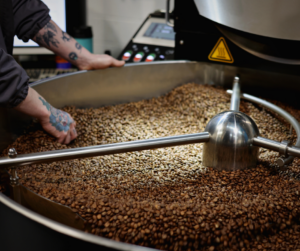
Roaster

Velo Coffee range
Cork-based Velo Coffee Roasters is proud to be part of the global B Corp movement, alongside a community of other inspiring Irish food producers who are committed to using business as a force for good. The certification independently verifies that the company meets high standards of social and environmental performance, accountability and transparency.
General manager, Suzanne Casey, states that “our B Corp certification reflects values that have always been central to the company’s approach to coffee, so it was a natural fit for the business and the entire team.” As a multi-award-winning speciality coffee roaster, the business focuses not only on exceptional quality but also on responsible sourcing and sustainable operations. Working with traceable coffee supply chains and continually improving energy and environmental practices within its roasting operations ensures sustainability is embedded across the business.
B Corp status reinforces Velo’s commitment to continuous improvement. They must regularly reassess their impact, constantly raise standards and deliver positive outcomes for people, communities and the environment.
Today’s shoppers are more conscious than ever about the environmental and social impact of the brands they buy. The B Corp mark provides retailers and consumers with a trusted, independently verified signal that a company is operating responsibly.
For retail partners, stocking a B Corp-certified brand like Velo and many others offers both quality assurance and sustainability credibility. As retailers continue to prioritise ethical and transparent brands, B Corp helps verify that every bag of Velo coffee represents not only great taste, but a commitment to better business, a more sustainable future and a coffee that brings global communities together.
Better food should be better

Strong Roots range
Strong Roots believes better food should be better. For consumers but better for the planet too. Since day one, sustainability has been built into how we grow our business, develop its products and work with partners across its supply chain. Strong Roots mission is simple: It believes food can be better and part of how it can do better is by making vegetables the hero of the plate while creating food that has a lighter footprint on the planet.
It knows that what we eat affects not only its health but the planet too. Strong Roots also knows that in order to mitigate against climate change it needs to encourage consumers to shift to a more plant rich diet. That is part of its mission at Strong Roots, all of its products are vegan, and it heros vegetables to be tasty, convenient and in accessible formats for consumers, to help make the right choice easier.
One of the ways it holds itself accountable is through its certification as a B Corporation. B Corp status, awarded by B Lab Ireland, recognises businesses that meet rigorous standards for social and environmental performance, transparency and accountability. For Strong Roots, it means being independently assessed across everything from its governance and environmental impact to how it supports its people and communities. It’s a commitment to doing business differently – balancing profit with purpose.
It shows up in our local communities where we have offices, Dublin, London and NYC. The brand makes donation commitments each year, this year it is on track to donate over 200,000 meals across its markets. Not only is it donating through these community partners, but it is also showing up. What really strengthens these partnerships for the brand is having its team volunteer within these organisations and in our communities. This kind of participation within its community has been embedded in the company’s DNA since day one.
But sustainability isn’t a finish line. From responsible sourcing and recyclable packaging to improving efficiency across its operations, it is constantly looking for ways to do better because building a better food system takes continuous progress and collective effort.
Cully & Sully: Ireland’s first B Corp food business

Partnerships with organisations such as FoodCloud, ALONE and Clean Coasts are just some of the ways the brand contributes to tackling food waste

Cully and Sully B‑Corp Certified since 2020
Cully & Sully has always believed that great food and responsible business should go hand in hand. Becoming a certified B Corp in 2020 was an important milestone for the brand, making Cully & Sully the first Irish food business to achieve the certification. It formalised a commitment that had long been part of the company’s ethos: doing business in a way that benefits people, communities and the planet.
B Corp certification measures a company’s impact across governance, employees, community and environment. For Cully & Sully, it provides a clear framework to ensure that decisions are guided not only by commercial success but also by positive social and environmental outcomes. Recertifying in 2023 reinforced this commitment and challenged the team to continue raising the bar.
Supporting local communities is a key part of this approach. Partnerships with organisations such as FoodCloud, ALONE and Clean Coasts are just some of the ways the brand contributes to tackling food waste, supporting vulnerable people and protecting Ireland’s natural environment. These initiatives sit alongside ongoing efforts to operate responsibly across the business, from sourcing ingredients thoughtfully to fostering a positive, supportive workplace culture.
Being part of the global B Corp community also brings accountability and collaboration. It connects Cully & Sully with other businesses that share the same ambition to balance purpose and profit while driving meaningful change within their industries.
Looking ahead, the brand is focused on continuing to improve its impact. That includes building on sustainability initiatives, strengthening community partnerships and ensuring that as the business grows, it remains firmly rooted in the values that led it to become a B Corp in the first place.
Tesco – A year of recognition for planet and community impact
It’s been a stellar year for Tesco Ireland’s ESG leadership, a year defined by ambition, action, and the exceptional dedication of colleagues across the business. Over the past 12 months, Tesco has secured five major ESG awards, each recognising a different dimension of its Planet and Community Plans. Together, they tell a powerful story: sustainability is not a side project, it’s how it operates, innovates, and serves.
February 2026: Green Retailer of the Year 2026 – Green Business Awards

Green Retailer of the Year 2026 – Green Business Awards
Winning this award once is an achievement. Winning it two years in a row is a statement. The 2026 Green Retailer Award celebrates the real, measurable progress being delivered every day across its business — from climate action and waste reduction to packaging improvements and responsible sourcing.
This back-to-back win reflects the consistency of its impact across the six pillars of its Planet Plan and the commitment of colleagues who continue to push for better outcomes for customers, communities, and the planet.
December 2025: ESG Award: Business and Finance Awards
This prestigious national award recognises Tesco’s leadership in environmental, social, and governance performance. Judges highlighted the strength of our longterm sustainability strategy and the dedication of colleagues who are embedding ESG into every part of the business.
This win reinforces that its progress is not just operational, it’s cultural. It reflects the values that drive it and the collective determination to meet our sustainability targets.
September 2025: Outstanding Achievement in Sustainable Business Impact – Chambers Ireland

Outstanding Achievement in Sustainable Business Impact – Chambers Ireland
Described by judges as “next level in social sustainability,” “innovative,” and “strategic,” this award recognises Tesco’s leadership in delivering sustainability that creates real community impact.
It celebrates the way Planet and Community Plans work hand-inhand, ensuring environmental progress is matched by meaningful social value.
September 2025: Best Community Programme – Chambers Ireland

Best Community Programme – Chambers Ireland
Tesco’s Stronger Starts Food Programme was honoured for its impact on children’s health and wellbeing, delivering free fresh fruit and vegetables to DEIS primary schools nationwide.
This award reflects the heart of its community commitment: supporting families, improving access to nutritious food, and partnering with schools to make a lasting difference.
September 2025: Best Energy Achievement in Retail – Business Energy Awards

Best Energy Achievement in Retail – Business Energy Awards
Tesco’s decarbonisation programme continues to set the pace for the retail sector. This award celebrates the scale and ambition of its energy transformation, including 50 biomethane trucks and a growing fleet of electric home delivery vans, 100% renewable electricity across all stores and offices, CO2 refrigerants, LED lighting, and smart building systems, and solar PV installations across 24 sites.
These achievements are only possible because of the expertise and passion of colleagues working across property, energy, logistics, and store operations, all driving towards a lower carbon future.
Across all five awards, one theme stands out: its colleagues are the driving force behind every success. Whether working in stores, distribution, head office, or with community partners, teams across Tesco Ireland have shown what’s possible when sustainability is embedded into everyday decisions.
These awards are not the finish line. They are milestones on its journey to meeting and exceeding its Planet Plan targets. They reaffirm that its strategy is working, its impact is growing, and its commitment is stronger than ever.
As it looks ahead, the focus remains clear: keep innovating, keep collaborating, and keep delivering for the communities and the planet it serves.
Tesco – A Year of Recognition for Planet & Community Impact
It’s been a stellar year for Tesco Ireland’s ESG leadership, a year defined by ambition, action, and the exceptional dedication of colleagues across the business. Over the past 12 months, Tesco has secured five major ESG awards, each recognising a different dimension of our Planet and Community Plans. Together, they tell a powerful story: sustainability is not a side project, it’s how we operate, innovate, and serve.
Feb 2026 – Green Retailer of the Year 2026 – Green Business Awards
Winning this award once is an achievement. Winning it two years in a row is a statement. The 2026 Green Retailer Award celebrates the real, measurable progress being delivered every day across our business — from climate action and waste reduction to packaging improvements and responsible sourcing.
This back‑to‑back win reflects the consistency of our impact across the six pillars of our Planet Plan, and the commitment of colleagues who continue to push for better outcomes for customers, communities, and the planet.
December 2025 – ESG Award – Business & Finance Awards
This prestigious national award recognises Tesco’s leadership in environmental, social, and governance performance. Judges highlighted the strength of our long‑term sustainability strategy and the dedication of colleagues who are embedding ESG into every part of the business.
This win reinforces that our progress is not just operational, it’s cultural. It reflects the values that drive us and the collective determination to meet our sustainability targets.
September 2025 – Outstanding Achievement in Sustainable Business Impact – Chambers Ireland
Described by judges as “next‑level in social sustainability,” “innovative,” and “strategic,” this award recognises Tesco’s leadership in delivering sustainability that creates real community impact.
It celebrates the way our Planet and Community Plans work hand‑in‑hand, ensuring environmental progress is matched by meaningful social value.
September 2025 – Best Community Programme – Chambers Ireland
Tesco’s Stronger Starts Food Programme was honoured for its impact on children’s health and wellbeing, delivering free fresh fruit and vegetables to DEIS primary schools nationwide.
This award reflects the heart of our community commitment: supporting families, improving access to nutritious food, and partnering with schools to make a lasting difference.
September 2025 – Best Energy Achievement in Retail – Business Energy Awards
Tesco’s decarbonisation programme continues to set the pace for the retail sector. This award celebrates the scale and ambition of our energy transformation, including:
- 50 biomethane trucks and a growing fleet of electric home delivery vans
- 100% renewable electricity across all stores and offices
- CO₂ refrigerants, LED lighting, and smart building systems
- Solar PV installations across 24 sites
These achievements are only possible because of the expertise and passion of colleagues working across property, energy, logistics, and store operations, all driving towards a lower carbon future.
Achievements to be proud of, and a platform for what comes next
Across all five awards, one theme stands out: our colleagues are the driving force behind every success. Whether working in stores, distribution, head office, or with community partners, teams across Tesco Ireland have shown what’s possible when sustainability is embedded into everyday decisions.
These awards are not the finish line. They are milestones on our journey to meeting, and exceeding our Planet Plan targets. They reaffirm that our strategy is working, our impact is growing, and our commitment is stronger than ever.
As we look ahead, the focus remains clear: keep innovating, keep collaborating, and keep delivering for the communities and the planet we serve.



Followers 0
Fans 0
Followers