

Stronger penalties proposed for adults purchasing ‘underage’ alcohol
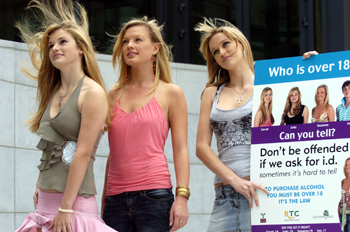
A report from the UK think-tank Demos entitled Sobering Up seeks tougher punishments for parents, friends and older siblings who ‘proxy-purchase’ alcohol in order to tackle harmful underage drinking in the UK. Could the Irish Government learn some lessons from this report?
 Print
Print19 December 2013


People who buy alcohol on behalf of underage drinkers should face community service, social shaming or be banned from shops, according to a new report from the UK cross-party think-tank Demos.
The authors of Sobering Up – Jonathan Birdwell, Ian Wybron and Emma Vandore – would encourage UK police and local authorities to use the threat of tougher punishments to discourage ‘proxy-purchasing’. Their report argues that community service with a strong focus on alcohol-related work such as clearing up city centres in the morning would be a justifiable penalty.
Other suggestions include banning people from their local off-licence or even prominently displaying posters by the counter to ‘name and shame’ those caught breaking the law in this way.
Demos goes on to argue that the police should do more both to enforce on-the-spot fines for law-breakers as well as using their powers to prosecute those potentially causing a great deal of harm by enabling underage drinkers.
While the current on-the-spot fine is just £90, police have the ability to impose a maximum fine of £5,000 on those convicted of purchasing alcohol on behalf of a child. However recent health select committee figures indicate that only 16 people were successfully prosecuted over a four-year span.
The report cites Portsmouth as the first local authority to introduce a ‘Proxywatch’ scheme – a 24-hour hotline for members of the public and shop staff to report incidences of proxy-purchasing. An important part of this campaign is raising awareness amongst retailers which has helped see the test-purchase failure rate for alcohol and tobacco fall from 33% to 2.5% in just four years.
Booze borders
The UK government’s most recent Alcohol Strategy blamed the availability of cheap alcohol for the problem of ‘pre-loading’ – people drinking substantially before going out into town centres.
In light of this, Demos urges a stronger focus on the role police and local authorities can play in tackling the problem of binge-drinking in the Night-Time Economy.
The report recommends police form ‘booze borders’, refusing entry into city centres for very drunk individuals in areas with high levels of alcohol-related crime or health problems.
Such a scheme has been trialled in Watford and Demos believes the idea could be rolled out as an effective deterrent elsewhere – either turning drunk individuals away, issuing a warning, or making them sober up in a designated area.
The report goes on to suggest charging individuals a levy towards policing and National Health Service costs or forcing them to carry out community work in the city centre to tackle the culture of binge-drinking during a night out.
The Sobering Up report argues that:
- local shops should offer training on how to refuse sale or provide tools such as panic buttons to help staff in local shops deal with rowdy, drunk customers
- health experts should target information campaigns specifically at parents to shift attitudes on the dangers of underage drinking
- young people should be shielded from ‘unsupervised’ drinking and drunkenness for as long as possible to decrease the risk of alcohol problems later in life.
Jonathan Birdwell, Head of the Citizens Programme at Demos and author of the report, commented, “The majority of teens get their alcohol through parents, friends and older siblings rather than buying it themselves. However, these proxy-purchasers aren’t facing the consequences for the harm they are doing.
“All the evidence shows that underage drunkenness increases alcohol risks later in life. The problem is especially severe in some parts of the country such as Liverpool, Birmingham and Leeds which have the highest numbers of under-18s being admitted to hospital due to alcohol.
“Our research suggests that tackling certain high strength drinks or just test-purchasing shops is not sufficient. We need a tougher, smarter approach. This includes threatening parents who buy alcohol for their children to drink unsupervised with ‘social shaming’ like community service. Giving drunk and disorderly people entering city centres a ‘yellow card’ and denying them entry or forcing them to sober up would also moderate excessive pre-loading by denying people the fun night out they had planned”.
James Lowman, the Chief Executive of the Association of Convenience Stores in the UK which supported the survey, commented, “Every day thousands of shop owners and workers are on the front line of tackling alcohol-related harm, they prevent underage sales and sales to drunks.
“They also engage with the wider community.
“We are pleased Demos have shone a light on the important role that shops play. The report also sets out some important challenges for the industry and policy-makers about how we move forward and address the problems that remain in our communities. We look forward to the debate that will follow this important report.”
Irish position on ‘proxy-purchasing’
The Intoxicating Liquor Act here states that anyone found selling alcohol to a minor is liable for a €4,000 fine on summary conviction for a first offence and €5,000 for a subsequent offence.
Those purchasing alcohol on behalf of a minor are liable to similar fines on conviction.
It’s also an offence to give alcohol to a minor in a domestic situation without the consent of the parent or guardian.
Anyone found guilty of forging or altering an official Age Card can be subject to a Class C fine of €2,500 or to a prison term not exceeding 12 months or both.
NOffLA response
There are two ways that alcohol is getting out to under-18s – by proxy or by parents, believes NOffLA Chairperson Evelyn Jones.
“We have serious laws about this already but they’re not being enforced,” she said, “There are fines here already that are much more stringent than those contained in this report but they’re simply not being implemented. “What’s the point in having these laws if they’re not going to be enforced,” she asked.
“With one swift campaign they could achieve what they did with the drink-driving. If it was made socially unacceptable for people to buy alcohol under the age of 18 then they wouldn’t do it.
“A day in court, a conviction and a fine would be just as effective.”
MEAS response
Following publication of the Demos report MEAS Chief Executive Fionnuala Sheehan pointed out, “It’s clear from the most recent (2011) European School Survey Project on Alcohol and Other Drugs figures for Ireland that although fewer 16 year-olds now drink alcohol, its perceived availability still remains at a high level.
“The Demos report also highlights the important influence of parents in providing alcohol to children and on children’s attitudes and behaviours towards alcohol,” she added, “We know that some parents provide alcohol to older children in a belief that introducing alcohol in the home is a good way to teach young people about responsible drinking. However the evidence shows that it’s best to delay the commencement of drinking as young people who start drinking at an early age drink more and more frequently than those who delay their first alcoholic drink. An alcohol-free childhood is best.”
ESPAD data suggests that Irish teens access much of the alcohol that they consume in their homes or friends’ homes, or that they find other people to purchase it for them.
Figures cited in the UK report include those from the Health & Social Care Information Centre which found that one-third of 11-15 year olds (33%) admitted obtaining alcohol in the previous four weeks. One in five (19%) were given the alcohol by parents whilst the same percentage also said they’d received it from their friends.
Around one in seven teenagers (13%) had asked someone else to buy alcohol for them compared with only 3% who had illegally purchased it from a shop themselves.
In contrast, ESPAD’s 2011 report (which aims to collect comparable data on substance use among teenagers in Europe at four-year intervals thus providing valuable information on the behaviour of 15-16 year-olds) had found:
- 84% of Irish16 year-olds believed that alcohol would be “fairly easy” or “very easy” to obtain, higher than the 81% average recorded for all countries surveyed
- 50% of Irish 16 year-olds report drinking alcohol in the last 30 days, down from 73% in 2007 and lower than the 57% average for all 36 European countries surveyed
- 37% of Irish 16 year-olds say that they purchased alcohol in a pub or disco ie in the “on-trade” in the last 30 days.
- 26% of Irish 16 year-olds say that they purchased alcohol in a shop, or the ‘off trade’, in the last 30 days. The European average, in contrast, was 37% for off-trade purchases and 45% for on-trade purchases.
“It’s encouraging to see that the percentage of underage purchases from on-trade and off-trade premises in Ireland is better than the European average,” concluded Fionnuala Sheehan, “It’s clear, however, that greater vigilance is required by licensees and staff and renewed action needed on adults purchasing alcohol for under-18s.? ?“I’d encourage all those involved to undertake training in responsible serving and selling of alcohol programmes, to learn the skills and the strategies to counteract underage purchasing of alcohol.
“Our online briefing tool can be accessed free-of-charge and we aim to make the more comprehensive Responsible Serving of Alcohol Programme affordable by providing a subsidy to the programme deliverer.”
Fáilte Ireland supports the Responsible Serving of Alcohol Programme developed by MEAS. In the last decade more than 14,000 full-time hospitality sector employees completed the in-depth program and it’s expected that 1,000 employees will have undertaken the RSA Programme in this calendar year.
Related Articles

Conor Neiland to lead Diageo Ireland →

A new era for an Irish icon →

Summer sips sales surge →




Followers 0
Fans 0
Followers